Losing a Jordanian national ID card, or having one become damaged, calls for a clear distinction between the two situations and prompt contact with the competent authority. The official service material treats a lost card and a damaged card as separate replacement categories and confirms a different fee for each. This article answers the question: How can I replace a lost or damaged Jordanian national ID card? It is based on the official material verified through 20 November 2026.
The information is general educational content. It is not legal advice and does not guarantee that an application will be accepted or completed within a particular period. Forms, procedures, fees, and operational requirements may change, so applicants should confirm the current position with the Civil Status and Passports Department or the official government service guide.
How can I replace a lost or damaged Jordanian national ID card?
The competent authority for issuing a replacement card is the Civil Status and Passports Department. The official lost-card service guide identifies the Department’s offices as the place where the service is provided. The official electronic-services page reviewed for this article did not list a separate online service for replacing a lost or damaged personal ID card. It listed other electronic services, including services related to passports and family books, but not this card-replacement service.
For a Jordanian citizen residing outside the Kingdom, the law permits applications to replace the card or obtain a replacement for a lost or damaged card to be submitted through a Jordanian consulate or through the Department. The appropriate location therefore depends in part on the applicant’s place of residence.
First step: report a lost card
When the card is lost, the process begins with a report to the nearest security centre. The service guide requires a report from the security centre, and the Department’s card-issuance instructions state that the applicant must bring a report confirming the loss. The service guide describes the security-centre report as electronic, using the wording “electronic security-centre report” among the required documents.
After making the report, the applicant should attend an office of the Civil Status and Passports Department to submit the replacement application under the prescribed forms and procedures. Based on the verified official process, a verbal statement at the Department does not replace the security report required for a lost-card application.
Time limit for reporting and requesting a replacement
The Civil Status Law provides that the holder of a personal ID card must notify the competent office within thirty days of the loss or damage and request a replacement for the lost or damaged card in accordance with the prescribed forms and procedures. This makes it important to record the date of the incident and begin the replacement process within the stated period.
The official material reviewed here does not establish one uniform completion time for issuing the new card. It would therefore be inappropriate to promise completion on a particular day or within a specific number of days. The relevant office can clarify any current operational timeframe when the application is submitted.
Documents for a lost-card replacement
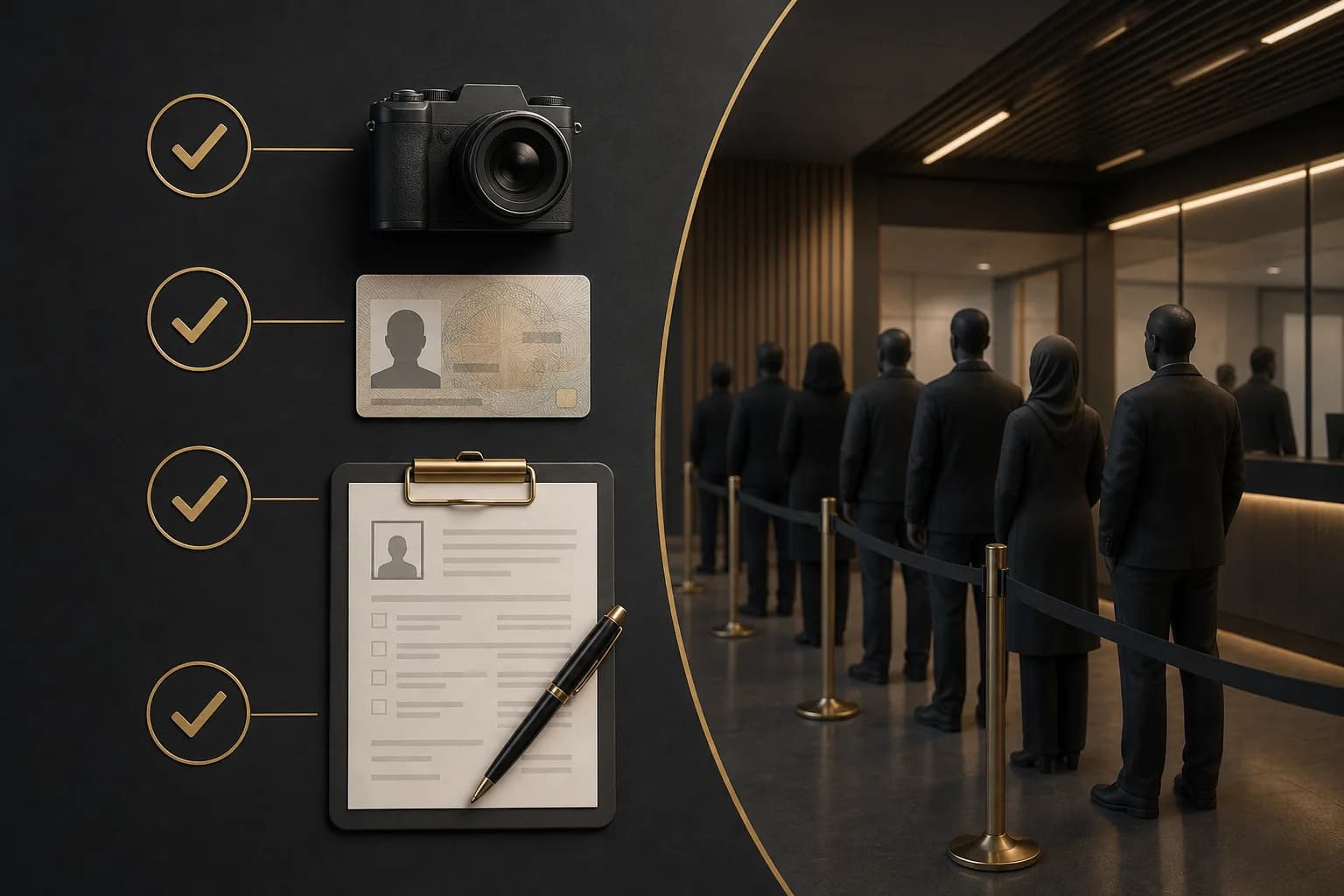
The lost-card service guide lists the following documents and requirements:
- The personal ID card application form.
- Proof of identity for the concerned person.
- A written undertaking where the loss is the first or second loss.
- One recent, coloured personal photograph.
- The security-centre report, shown in the guide as electronic.
Additional requirements may apply depending on the circumstances. For a third loss, the guide lists a statement of the loss before an investigation committee and a financial guarantee. For members of the military, it lists a letter from the General Command approving issuance of the card. It also lists a bridge-statistics card for persons to whom that requirement applies.
The Department’s instructions further require the photograph to be recent and coloured, with a white or grey background, and to meet the specifications stated in the instructions. Preparing a photograph that meets those specifications can help avoid an unnecessary return, although acceptance remains subject to the Department’s requirements at the time of application.
Who must submit the application?
The general rule is that the concerned person submits the application and attends in person. The service guide states that a power of attorney or authorisation is not accepted for this service. For a minor, the parent or legal guardian submits the application and attends personally. The card-issuance instructions also state that applications for minors under sixteen are submitted by the parent or legal guardian with personal attendance.
This means that sending another person in place of the applicant may not be accepted, except within the specific rule applicable to minors. The applicant should therefore confirm who must attend, particularly where the case involves a minor, military status, or another special category.
What is the difference between a lost and a damaged replacement?
A lost-card replacement concerns a card that is no longer available to its holder because it has been lost. The official guide expressly connects this category with a security-centre report. A damaged-card replacement concerns a card that remains with the holder but is damaged or no longer usable. The law records different fees for the two categories:
- Replacement of a damaged personal ID card: three Jordanian dinars.
- Replacement of a lost personal ID card: five Jordanian dinars.
The law requires notification within thirty days in both cases. However, the verified official material expressly establishes the security report within the lost-card service guide; it does not establish that the damaged-card requirements are exactly identical. The lost-card document list should therefore not be treated automatically as the complete damaged-card checklist. The applicant should confirm the requirements for the specific situation with the Department.
What if the card is found after the loss has been reported?
The official material available for this article confirms the reporting obligation and the lost-card replacement process, but it does not explain the complete legal or administrative effect of using a card after it has been reported lost. It also does not establish a universal rule stating whether use is accepted or rejected in every situation. No general conclusion should therefore be assumed.
If the card is found after the report, the holder should not rely on a personal assumption about its continuing validity. Instead, the holder should ask the Civil Status and Passports Department or the relevant official authority what must be done before using or surrendering the card. This question is separate from the obligation to report and request a replacement within the stated period.
Practical checklist before visiting the Department
- Identify whether the card is lost or damaged.
- If it is lost, make the security-centre report and retain its details.
- Calculate the thirty-day period from the date of the loss or damage.
- For a lost-card application, prepare the form, proof of identity, and one recent coloured photograph.
- Check whether the matter involves a third loss, military status, or a bridge-statistics card requirement.
- Arrange for the concerned person to attend, or for the parent or legal guardian to attend in the case of a minor. Do not rely on a power of attorney or authorisation.
- Confirm the current fee and procedure with the office. The fees confirmed in the official material are three dinars for a damaged replacement and five dinars for a lost replacement.
Frequently asked questions
Can I apply online for a lost-card replacement?
The official electronic-services page reviewed for this article did not list a separate electronic service for this application. The lost-card guide identifies the Civil Status and Passports Department’s offices as the service location.
Is a security report required when the card is damaged?
The verified material expressly confirms the security report for a lost-card application. It does not establish that the same requirement applies in exactly the same way to a damaged card. The Department should be asked to confirm the current damaged-card requirements.
Can another person submit the application?
The guide requires the concerned person to apply and states that a power of attorney or authorisation is not accepted. A parent or legal guardian submits and attends personally for a minor.
How long does issuance take?
The material reviewed does not provide one standard completion period. The relevant office should be asked about the current timeframe when the application is filed.
Conclusion
For a lost card, the clearest verified route is to report the loss to a security centre, then attend an office of the Civil Status and Passports Department with the required documents and within the thirty-day period. A damaged card should be treated as a separate category and its specific requirements confirmed, because the available service guide reviewed here is principally a lost-card guide. Where the facts involve a third loss, a minor, military status, residence abroad, or uncertainty about a card found after reporting, a professional review of the facts and available documents may help clarify the next step.
Official sources
- المادة 52 يعاقب كل من خالف احكام أي من المواد (4 — Accessed 2026-11-20
- مصدر رسمي — Accessed 2026-11-20
- الخدمات الالكترونية - دائرة الأحوال المدنية والجوازات — Accessed 2026-11-20
- # شروط إصدار البطاقات الشخصية: — Accessed 2026-11-20