
If you plan to operate a business or professional activity within the boundaries of Greater Amman Municipality, licensing should be addressed before leasing, fitting out, or opening the premises. The question, “How do I obtain and renew a vocational licence in Amman, Jordan, and what documents are required?” involves more than submitting a form and paying a fee. It also requires checking whether the activity is permitted at the proposed location and whether the relevant documents, inspections, and approvals are in place.
This article presents a practical overview of the general process based on the official research material provided for this topic. Requirements may vary according to the activity, location, building, and applicable external approvals. Current requirements should therefore be verified with Greater Amman Municipality and the relevant government authorities before an application is submitted.
Important notice: This is general educational information, not legal advice. It does not guarantee that an application will be accepted or that a licence will be issued. A particular case may require professional review of the premises, documents, classification, and approvals.
Which authority issues a vocational licence in Amman?
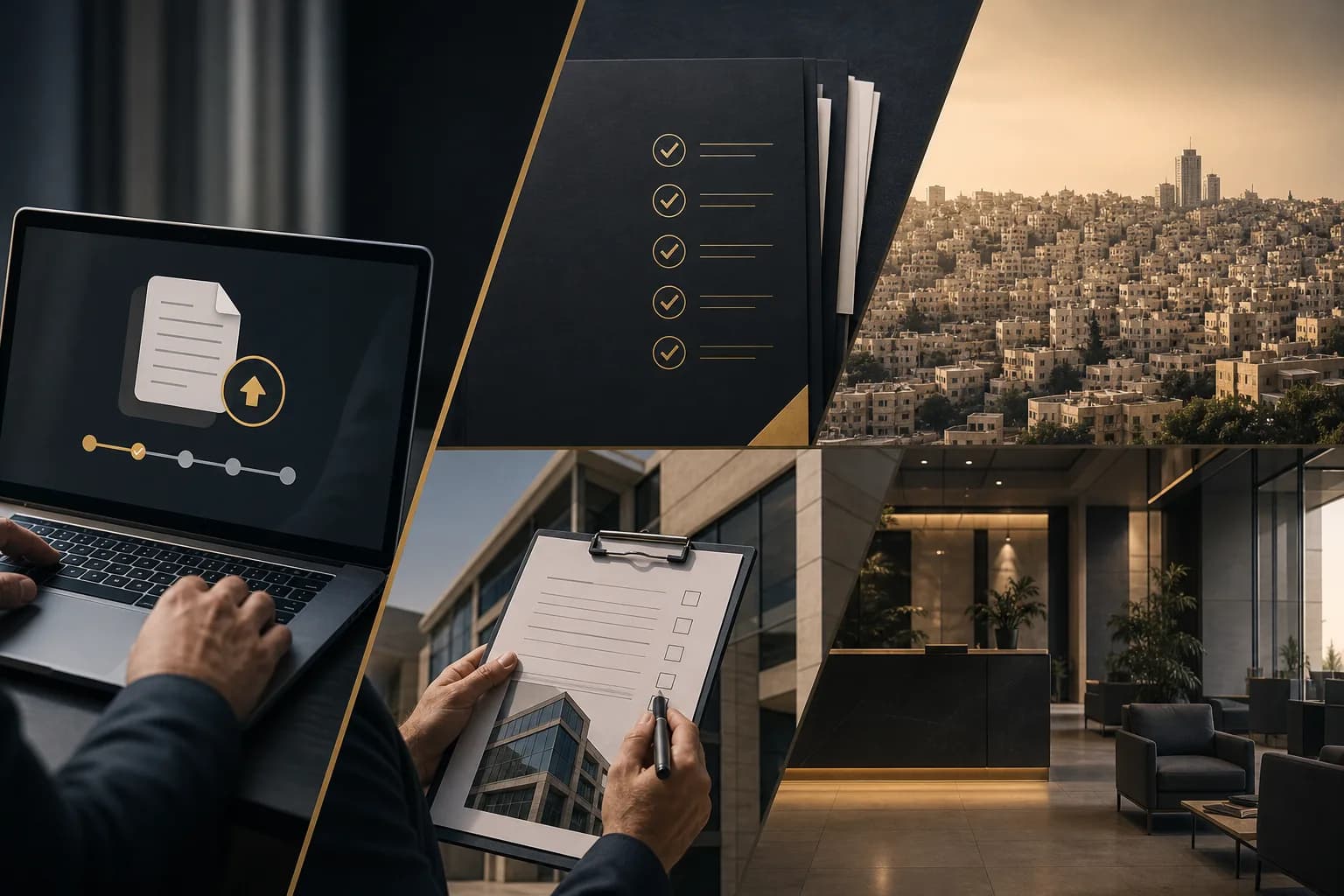
Greater Amman Municipality is the primary authority for vocational licensing where the activity is conducted within its boundaries. The licence allows the premises to be used for the relevant economic activity in accordance with the applicable laws, regulations, and instructions.
However, the Municipality may not be the only authority involved. Depending on the nature of the activity, the application may require approval from Civil Defence, a professional body, or a competent health authority. Identifying the activity accurately at the outset is important because the description of the business can affect the required documents, inspection process, external approvals, and expected processing track.
What should be checked before applying for a vocational licence?
The first practical question is whether the proposed activity is permitted at the chosen location. The competent municipal framework determines which professions may be practised in particular areas, taking into account the applicable urban, building, zoning, and planning rules in Amman.
Owning the property or holding a commercial registration is not, by itself, enough. The activity must be compatible with the zoning and permitted use of the premises, and the site must meet the structural, health, and professional requirements applicable to that activity. Depending on the instructions, certain activities may be carried out in buildings, premises, subdivided buildings, virtual offices, vehicles or machinery dedicated to the profession, or self-service machines.
- Define the actual activity and the place where it will be conducted.
- Check whether the activity is permitted under the location’s zoning and planning requirements.
- Confirm that the building and relevant construction documents are valid and available.
- Identify any professional, health, or Civil Defence approval that may apply.
- Prepare the core documents before submitting the electronic application.
What documents are required to obtain a vocational licence?
The general government licensing guide identifies several core documents. Additional documents or approvals may be required depending on the activity, premises, and building. The core list includes:
- Building assessment certificate for older buildings: applicable to existing buildings constructed before 1969.
- Proof of ownership of the property.
- A valid occupancy permit.
- A construction licensing certificate: for activities that require construction licensing in order to be conducted at the premises.
The regulatory framework also indicates that a specific system determines the required documents and information, including a registration certificate from the competent authority and a membership certificate from the relevant chamber of commerce or industry, as applicable. The general list should therefore not be treated as a complete checklist for every business.
Before filing, it is sensible to compare the documents, names, property details, and validity dates. Missing documents or inconsistencies between the activity and the premises may lead to a request for correction or completion and can delay the application.
What is the application, inspection, and approval process?
The general procedure described in the government licensing guide is electronic. It may be summarised as follows:
- Submit the vocational licence application electronically and enter the activity and location details.
- Upload the documents required for review.
- Schedule an inspection where an inspection is required.
- Correct the premises or complete the file if non-compliance or missing information is identified.
- Refer the application to the relevant committee or technical department when required.
- Obtain external approvals applicable to the activity.
- Receive notification of the fees due.
- Pay the fees electronically.
- Have the licence issued electronically and download it after payment.
The legal framework classifies applications into three levels. A specialised application requires a prior inspection and approvals from the competent authorities; its stated period after the conditions are satisfied is seven working days. A conditional application requires approvals from committees or technical directorates and may require a prior inspection; its stated period is three working days. A fast-track application does not require a prior inspection where all requirements and approvals are complete; its stated period is one working day.
The research material states that if these periods expire, the licence is deemed issued under the legal provision. The government guide also refers to a general service period of five days. These references should be read together: the five-day period is a general procedural period in the guide, while the legal periods depend on the application’s classification and actual compliance. The precise period cannot be identified without knowing the classification and whether the file is complete.
Do requirements differ between activities?
Yes. An activity that does not require an inspection or external approval may follow a faster route than a specialised activity requiring technical assessment or approval by another authority. Requirements may also vary according to the location, building type, construction status, health requirements, and whether Civil Defence approval is applicable.
For that reason, filing under a broad or inaccurate business description can create avoidable problems. The activity should be described accurately, and the proposed premises should be identified before the application is prepared. The available documents can then be compared with the current service requirements.
How do I renew a vocational licence in Amman?
The vocational licence is valid from 1 January through 31 December. The Municipality’s service information states that renewal is submitted electronically using the licence number. The required documents are attached, the fees are paid electronically, and the renewed licence can be downloaded after payment is completed.
The regulatory framework provides that the licence is renewed automatically through a notice submitted by the licensee to the Municipality on the approved form within three months from the date on which the licence expires. At renewal, proof of continuing registration with the competent authority or its approval is not required unless that authority has notified the Municipality that the registration, approval, or licence has been cancelled or permanently withdrawn.
It is still prudent not to leave renewal until the end of the permitted period. The licence number, activity, premises information, supporting documents, and any changes affecting the business should be reviewed before the electronic submission and payment are completed.
What are the consequences of late renewal or operating without a licence?
If the licence is not renewed within the designated renewal period, a late charge of 5% per month applies, subject to a maximum of 15% of the licence fee. The licensee is not subject to the fee and late charges if they prove that the profession was not practised at the premises, in accordance with the documents specified by the applicable instructions.
Operating a profession within the Municipality’s boundaries requires a licence or permit under the applicable law, regulations, and instructions. Conducting the activity without completing the licensing process may therefore expose the operator to regulatory measures or a requirement to correct the status, depending on the facts and the competent authority. The research material does not provide a sufficient basis for stating one fixed penalty or outcome for every type of activity, so assumptions should be avoided.
The available regulatory material also states that the Mayor may cancel a licence if it is not renewed for three years from its expiry date. Because the quoted material is incomplete at that point, the full text and current application details should be checked before dealing with a licence that has been expired for an extended period.
Frequently asked questions
Is proof of ownership enough to obtain the licence?
No. Proof of ownership is a core document, but it does not replace a valid occupancy permit, the older-building assessment certificate where applicable, or a construction licensing certificate where the activity requires one. The activity must also be permitted at the chosen location.
Does every application require a prior inspection?
No. Applications are classified as specialised, conditional, or fast-track. A fast-track application may proceed without a prior inspection if its requirements and approvals are complete, while a specialised application requires a prior inspection and the relevant approvals.
Will every application be completed within five days?
The government guide refers to a general service period of five days. The legal periods, however, differ by classification: seven working days for a specialised application, three working days for a conditional application, and one working day for a fast-track application, once the relevant requirements have been satisfied.
Do these procedures apply outside Greater Amman Municipality?
They should not be assumed to apply outside the Municipality’s boundaries. The material discussed here concerns activities within Greater Amman Municipality, and the authority, documents, and procedure may differ elsewhere in Jordan. The municipality or government authority responsible for the proposed location should be consulted.
Practical conclusion
Start by defining the activity and location, then confirm that the proposed use is permitted and that the building documents are available. Prepare the ownership document, occupancy permit, and any other documents applicable to the activity and premises. Submit the application electronically, monitor document review, inspection, and external approvals, pay the fees, and download the issued licence.
For renewal, use the licence number, submit the required notice and documents within the applicable period, and complete electronic payment. If the activity classification or property status is unclear, a professional review before filing may help reduce delays and avoid commencing operations before licensing is complete. Attorney Yasmin Abu Hadba’s office can assist with understanding the relevant requirements and reviewing the application pathway based on the facts of your situation, without replacing the competent authority’s decision.
Official sources
- 3608 الجريدة الر سمية نحن عبدهللا الثاني ابن — Accessed 2026-11-24
- الخطوة رقم (6): الحصول على الرخص المهنية — Accessed 2026-11-24