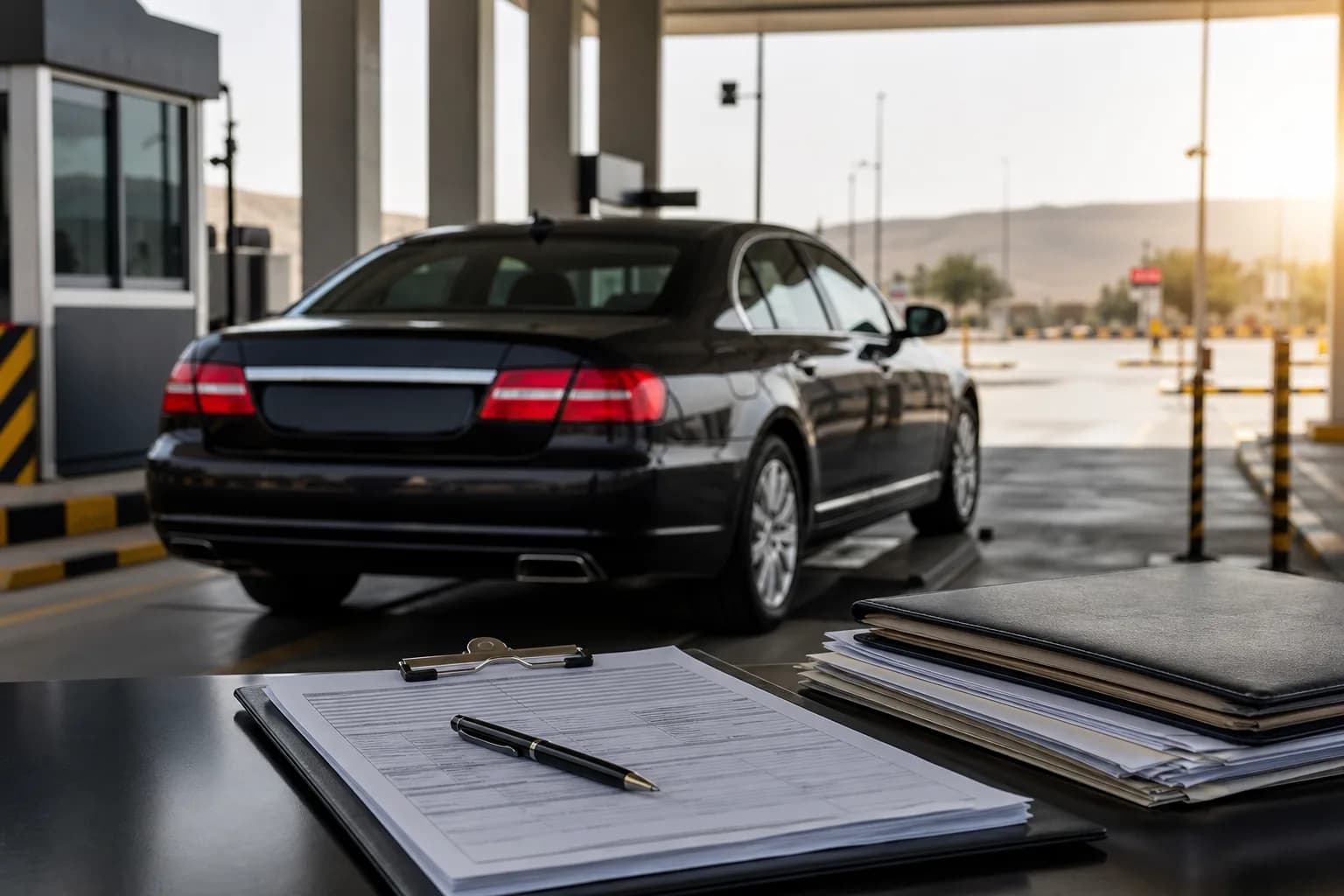
Many vehicle owners ask: How do I register an imported vehicle for the first time in Jordan, and what documents and fees are required? The answer begins with import and customs clearance and does not end with payment. The vehicle’s identity, ownership records, technical specifications, and compliance with official requirements must also be checked before the technical inspection, licensing, and issuance of plates.
First-time registration is best treated as a connected sequence of steps. A missing customs document, an inconsistency in the chassis number, or uncertainty about the vehicle’s condition may delay the application or lead to a refusal until the issue is corrected. Jordan also introduced updates affecting vehicle registration and licensing during 2026. For that reason, current requirements should be confirmed directly with the Driver and Vehicle Licensing Department and the Jordan Customs Department before filing.
This article is general educational information, not legal or customs advice, and it does not guarantee acceptance of an application or any particular outcome. Final requirements depend on the vehicle’s details, the basis of import, and the laws and instructions in force when the application is submitted.
How Do I Register an Imported Vehicle for the First Time in Jordan, and What Documents and Fees Are Required?

For a typical imported vehicle intended for permanent registration, the practical route generally includes completing customs requirements, verifying ownership and vehicle details, presenting the vehicle to a technical inspection committee, submitting the required documents to the licensing authority, having the file reviewed, paying the applicable fees, and obtaining the vehicle registration licence and plate issuance order. The exact process may vary according to the vehicle’s category, condition, location, and import arrangement.
1. Confirm the import requirements
The import instructions published through the official customs portal state that imported goods are generally exempt from an import licence, except for goods listed in the relevant schedules. If the imported item requires an import licence, the importer must be registered in the importers’ register and hold a valid importer card.
The instructions also identify exceptions from the importer-card requirement, including personal imports by a natural person within a specified annual limit and cars cleared in free zones. Where a card or import licence is required, the customs declaration, clearance, or release of the goods against an undertaking cannot proceed until the relevant requirements have been met.
Accordingly, the first practical question is how the vehicle was imported. Is it a personal import? Was it cleared in a free zone? Does the specific case require an importer card or an import licence? The answer cannot be assumed from another vehicle owner’s experience, because the document requirements may depend on these facts.
2. Verify ownership and technical information
All vehicle records should be checked for consistency, particularly the vehicle type, model year, chassis or VIN number, country of origin, and condition. Particular attention may be needed where the vehicle is damaged, modified, or subject to special restrictions.
The importer is responsible for ensuring that imported goods comply with applicable Jordanian standards and with requirements or recommendations issued by other official bodies. For some vehicle categories, additional technical conditions or import restrictions may apply. The safest approach is therefore to obtain confirmation linked to the specific vehicle rather than relying on a general statement or a previous transaction involving a different vehicle.
3. Complete customs clearance
Published government service information for unregistered vehicles and certain special cases identifies the vehicle customs declaration as a required document. This indicates that the vehicle’s customs status must be completed before the licensing process can properly move forward.
Before leaving the customs stage, the information in the customs declaration should be compared with the ownership documents and the vehicle itself. Any difference in the chassis number, description, or condition may need to be addressed with the competent authority before the registration application is submitted.
4. Attend the technical inspection
The published service sequence includes presenting the vehicle to a technical inspection committee. The purpose is to verify the vehicle’s technical condition and identifying information before the licence and plates are issued. Customs clearance or payment of fees does not replace this inspection.
The Public Security Directorate announced that new technical inspection instructions began operating on 10 May 2026. The announcement referred to the inspection of certain small passenger vehicles no more than five years old when they are registered for the first time. The exact application depends on the operative text and the vehicle category, so the required inspection should be confirmed before attending.
5. Prepare the supporting documents
Based on the published government service sequence, the file will generally include the vehicle customs declaration, documents establishing the legal connection to the vehicle, and the personal or representative documents required for the applicant. It may also include import-related documents, an import licence, or a valid importer card where applicable. The published service information also refers to arranging insurance for the vehicle.
This should not be treated as a complete checklist for every case. Additional documents may be requested depending on whether the vehicle was imported for personal use, cleared in a free zone, or affected by a special technical or legal circumstance. It is prudent to organise the original documents and any required copies, check their validity, and ensure that names and numbers match throughout the file.
6. Understand what can be confirmed about fees
The final stage includes reviewing the documents, entering the vehicle information, collecting the applicable fees, and issuing the vehicle registration licence and plate issuance order. However, the official material reviewed for this article does not establish a single final amount for customs duties, registration fees, and licensing fees for every imported vehicle registered for the first time.
During 2026, the Prime Ministry announced the approval of an amended system concerning driving licence fees and vehicle registration and licensing, as well as an amended system concerning vehicle registration and licensing. The announcements referred to simplifying the calculation of certain fees and renewal procedures, but they did not publish a complete detailed schedule identifying the amount payable for every first-time imported-vehicle registration.
For that reason, an unofficial estimate or a figure circulating online should not be treated as conclusive. The applicant should request an official calculation based on the vehicle’s details and the systems and instructions in force at the time of filing. Any applicable customs, registration, licensing, inspection, or plate charges should be confirmed as part of that calculation.
What if the application is refused?
A refusal does not necessarily establish that the vehicle can never be registered. The first step is to identify the precise reason: a missing document, inconsistent information, an inspection result, a customs requirement, or an import restriction. The issue should then be addressed with the authority responsible, while retaining evidence of any correction or completion.
If the reason is unclear, the applicant may request clarification of the missing requirement or technical observation and review the file before resubmitting it. Where the refusal involves a dispute over ownership, an interpretation of a procedure, or a legal effect that is not clear from the written decision, professional review may help identify the appropriate next step without assuming a particular result.
Frequently asked questions
Does every imported vehicle require an importer card?
Not necessarily. The instructions identify exceptions, including personal imports within the specified annual limit and cars cleared in free zones. If the imported item requires an import licence, however, the importer must be registered in the importers’ register and hold a valid importer card. The relevant exception must be confirmed for the particular vehicle and transaction.
Is the customs declaration enough to obtain the registration licence?
No. The customs declaration is an important part of the file, but the published sequence also includes technical inspection, document review, data entry, payment of fees, and issuance of the licence and plate order.
Can the exact fees be known before inspection?
An official estimate or calculation may be available, but the reviewed research does not establish one universal final amount. The payable amount depends on the vehicle’s specific data and the systems and instructions in force when the application is filed.
Where should current requirements be checked?
Current requirements should be confirmed with the Driver and Vehicle Licensing Department through its official domain, dvld.gov.jo, and with the Jordan Customs Department through customs.gov.jo. The applicant should specifically verify import, customs clearance, inspection, registration, and fee requirements before taking a final step.
A practical conclusion for professional review
First-time registration of an imported vehicle begins with identifying the import and customs position, checking ownership and technical information, completing the customs declaration, passing the technical inspection, submitting the required documents, and finally completing data entry, payment, licensing, and plate issuance. Because the official material reviewed does not provide one complete fee table for every imported vehicle and because 2026 updates may affect the process, official confirmation remains essential.
Professional review can assist with organising the facts and documents, understanding a delay or refusal, and identifying the authority to approach. It does not replace official verification and cannot guarantee acceptance of the application.
Official sources
- القيود أو المحظورات المتعلقة بالاستيراد أو التصدير أو الترانزيت — Accessed 2026-11-21
- ةقاعلاإ يوذ /ةيصوصخلا ةفصلاب ةلجسملا ريغصلا بوكرلا تابكرم ليجست : ةمدخلا ىمسم ماقرأ تاحول اهحنم ( ةكلمملا ضرأ ىلا لوخدلل ينوناقلا قحلاو نذلاإ تابكرملا حنم اهللخا نم متي ةلماعم يه : — Accessed 2026-11-21
- قرارات لمجلس الوزراء تتعلق بالواقع التَّنموي لمحافظة إربد وتشريعات لتطوير النقل وخدمات ترخيص المركبات وتحسين بيئة الأعمال والاستثمار - رئاسة الوزراء — Accessed 2026-11-21