The Jordanian Personal Status Law serves as the family constitution governing the finest details of the marital relationship, deriving its provisions from Islamic Sharia while accounting for contemporary developments that safeguard the status of women. Under Jordanian legislation, a wife is not merely a party to a contract; she is a partner who enjoys legal immunity guaranteeing her a life of dignity and stability.
The primary aim of this law is to establish a balance that prevents either party from dominating the other, and it lays down clear foundations for the financial and moral rights that accrue to the wife upon the conclusion of the marriage contract.
Most Important Rights of a Wife Under Jordanian Personal Status Law
The Jordanian Personal Status Law is the principal reference that precisely defines the rights and obligations of both spouses. The rights of the wife are as follows:
The Wife's Right to the Dowry (Mahr)
Under Jordanian legislation, the dowry is a fundamental and exclusive right of the wife arising from the moment the valid marriage contract is concluded. It is deemed her private property in which neither the husband nor the father may interfere. The dowry may be prompt (mu'ajjal), payable at the time of contracting, or deferred (mu'ajjal), falling due upon divorce or death. The husband is not lawfully entitled to withhold or delay payment of the dowry without legitimate justification, and the wife has the right to withhold herself from the husband until she receives her prompt dowry, in accordance with the provisions of the Jordanian Personal Status Law.

Jordanian Personal Status Law
The Wife's Right to Financial Maintenance (Nafaqah)
Financial maintenance is a religious and legal obligation owed by the husband to his wife from the moment the valid marriage contract is concluded and she makes herself available to him. It encompasses all essential needs including food, drink, clothing, and medical care. One of the notable features of Jordanian law is that the husband remains obligated to provide maintenance even if the wife is wealthy or has an independent income, as maintenance is linked to the marriage contract and the husband's financial capacity.
The Wife's Right to Accommodation
The husband is obligated to provide his wife with a lawful and suitable residence that meets conditions of safety, privacy, and comfort. The residence must be independent, and the law takes into account prevailing social custom and the husband's financial capacity in determining the standard of accommodation, such that it is furnished with the basic necessities of life. The wife may not be compelled to reside with the husband's family except with her full and free consent.
The Wife's Right to Kind and Equitable Treatment
The Jordanian Personal Status Law requires the husband to treat his wife with kindness, founded upon the principles of affection and mercy. This right encompasses mutual respect and the avoidance of anything that causes the wife psychological or physical harm. The relationship must be based on mutual understanding; the husband may not demean his wife's dignity or belittle her standing — rather, he is obligated to protect her and provide for her psychological well-being.
How to Handle Divorce Cases in Jordan to Recover Your Full Legal Rights?
The Wife's Right to Education and Employment
Jordanian law does not prevent the wife from exercising her natural right to pursue education or work outside the home in order to develop herself and achieve economic independence. Nevertheless, the law stipulates that her work must not conflict with the essential interests of the family. Where the husband expressly or implicitly consented to her working at the time of marriage, he may not subsequently withdraw that consent except on strong and substantiated legal grounds that are demonstrably harmful to the family unit.
The Wife's Right to Inheritance
The wife holds an inherent right to inherit from her deceased husband, receiving her legally prescribed share as precisely determined in the Law of Inheritance appended to the texts of the Jordanian Personal Status Law. The wife receives one-quarter of the estate if the husband leaves no direct heirs, and one-eighth where children exist. The law guarantees that this right reaches her in full and prevents any attempt to deprive her of her legally prescribed share.
The Wife's Right to Child Custody
In cases of separation, custody is granted to the mother as the primary priority for the care of young children, given that she is most capable — emotionally and physically — of raising them in their early years. The legislation grants the mother priority in order to protect the best interests of the child. This custody continues for the mother as long as she fulfils the Sharia-based conditions specified by the Jordanian Personal Status Law, with the father remaining obligated to bear all financial costs arising from this custody arrangement.
The Wife's Right to Divorce on Grounds of Harm (Talaq lil-Darar)
The wife is entitled to petition the court for divorce if she has been subjected to any form of harm that renders the continuation of marital life impossible. Harm encompasses ill-treatment, persistent humiliation, physical abuse, or prolonged desertion. In such cases, the court investigates the alleged harm, and if it is established, the spouses are judicially separated with the wife's financial rights arising from that separation preserved in accordance with the law.

Jordanian Personal Status Law
The Wife's Right to Mut'ah (Consolation Compensation) After Divorce
If the husband divorces his wife by his own unilateral will without legitimate justification, the law obliges him to pay her financial compensation known as mut'ah. This compensation is assessed according to the husband's financial circumstances, the duration of the marriage, and the extent of the injustice suffered by the wife, such that it shall not be less than one year's maintenance nor exceed three years' maintenance, as reparation for psychological and material harm in accordance with the standards of the Jordanian Personal Status Law.
The Wife's Right to Equitable Treatment in Cases of Polygamy
Should the husband choose to take more than one wife, the Personal Status Law obliges him to achieve absolute equity among his wives in all material and living aspects. The husband must be equitable in maintenance, accommodation, and conjugal cohabitation. Any deliberate breach of this equity or favoritism toward one wife entitles the aggrieved wife to resort to the courts to demand her rights or to seek divorce on grounds of harm arising from the failure to fulfil the condition of equitable treatment.
The Wife's Right to the Deferred Dowry Upon Divorce or Death
The wife is entitled to claim the deferred dowry registered in the marriage contract upon the termination of the marital relationship, whether by divorce or the husband's death. The deferred dowry is deemed a preferential debt upon the husband, extracted from his estate prior to the distribution of any inheritance in the event of death. This provision guarantees the woman a financial safeguard that protects her from hardship and need following the loss of her life partner.
The Wife's Right to Maintenance After Divorce
The wife's maintenance does not lapse immediately upon divorce; the divorced wife is entitled to maintenance during the waiting period ('iddah) if the divorce is revocable (raj'i). Where the divorce is irrevocable (ba'in), the wife may be entitled to mut'ah compensation and other indemnities, in addition to the continuation of her right to child custody maintenance and accommodation allowance if she has custody of the children, so as to ensure the stability of her life after separation.
Read also:Rights of Persons Subject to Deportation Orders and Legal Procedures for Challenging Them in Jordan
The Wife's Right to File Complaints Before the Courts
The law guarantees the wife the right to resort to the Personal Status Court to demand any of her rights that the husband may refuse to fulfil. These courts are distinguished by the existence of enforcement divisions that ensure the prompt collection of maintenance payments and financial entitlements, as well as family reconciliation offices that endeavour to resolve disputes amicably before final judicial rulings are issued, all while protecting family privacy in accordance with the procedures of the Jordanian Personal Status Law.
Practical Advice for Wives
To ensure the protection of these rights, the wife should follow the steps below:
- A copy of the marriage contract must be kept in a safe place and any additional financial agreements must be documented.
- It is also important to read and become acquainted with the provisions of the Jordanian Personal Status Law, as knowledge is the first step toward protection.
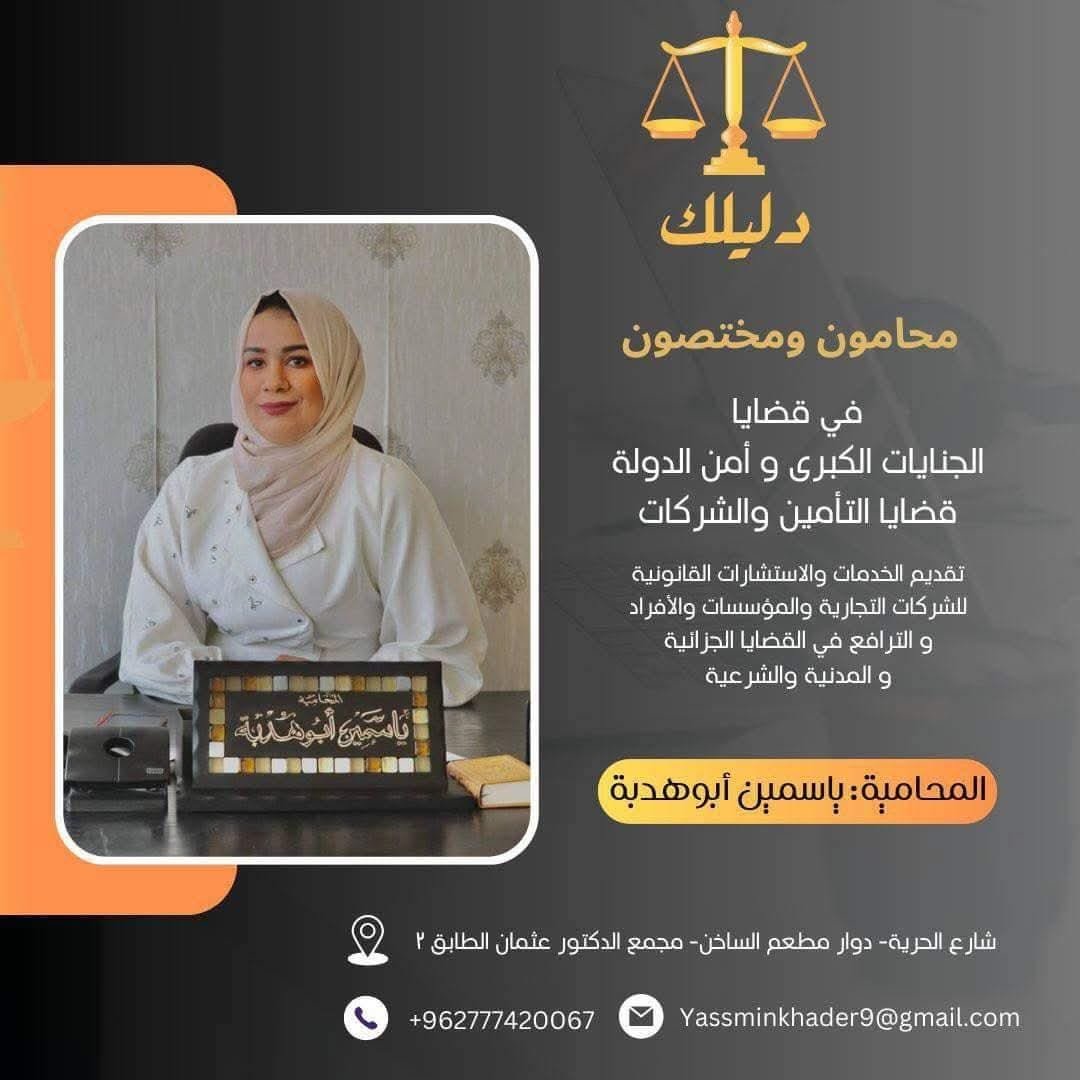
- In the event of a dispute, a specialist attorney such as Attorney Yasmin Abu Hadba, who handles Sharia cases, should be consulted to ensure that claims are properly formulated in legally sound terms before the judge.
Frequently Asked Questions
When does a wife become entitled to mut'ah compensation?
She becomes entitled to it if the husband divorces her by his own unilateral will without legitimate justification, and it is assessed at between one and three years' maintenance.
Does the wife's right to maintenance lapse if she is employed and has a salary?
No. Maintenance is an obligation upon the husband regardless of the wife's financial situation or her personal income.
The rights of a wife under the Jordanian Personal Status Law are not mere concessions; they are legal and Sharia-based entitlements designed to preserve a woman's dignity and ensure a balance of power within the family. Understanding and awareness of these rights contributes to building a society founded on justice and affection, and reduces instances of abuse and injustice. A wife's knowledge of her rights is the primary pillar of the stability of her life and the protection of her children's future.
Learn more:Sharia Cases in Jordan: A Comprehensive Guide Under the Personal Status Law
Everything You Need to Know About Divorce in Absentia Under Jordanian Law
Grounds for Deportation and Its Legal and Social Consequences in Jordan