Jurisdiction of Sharia Courts in Jordan
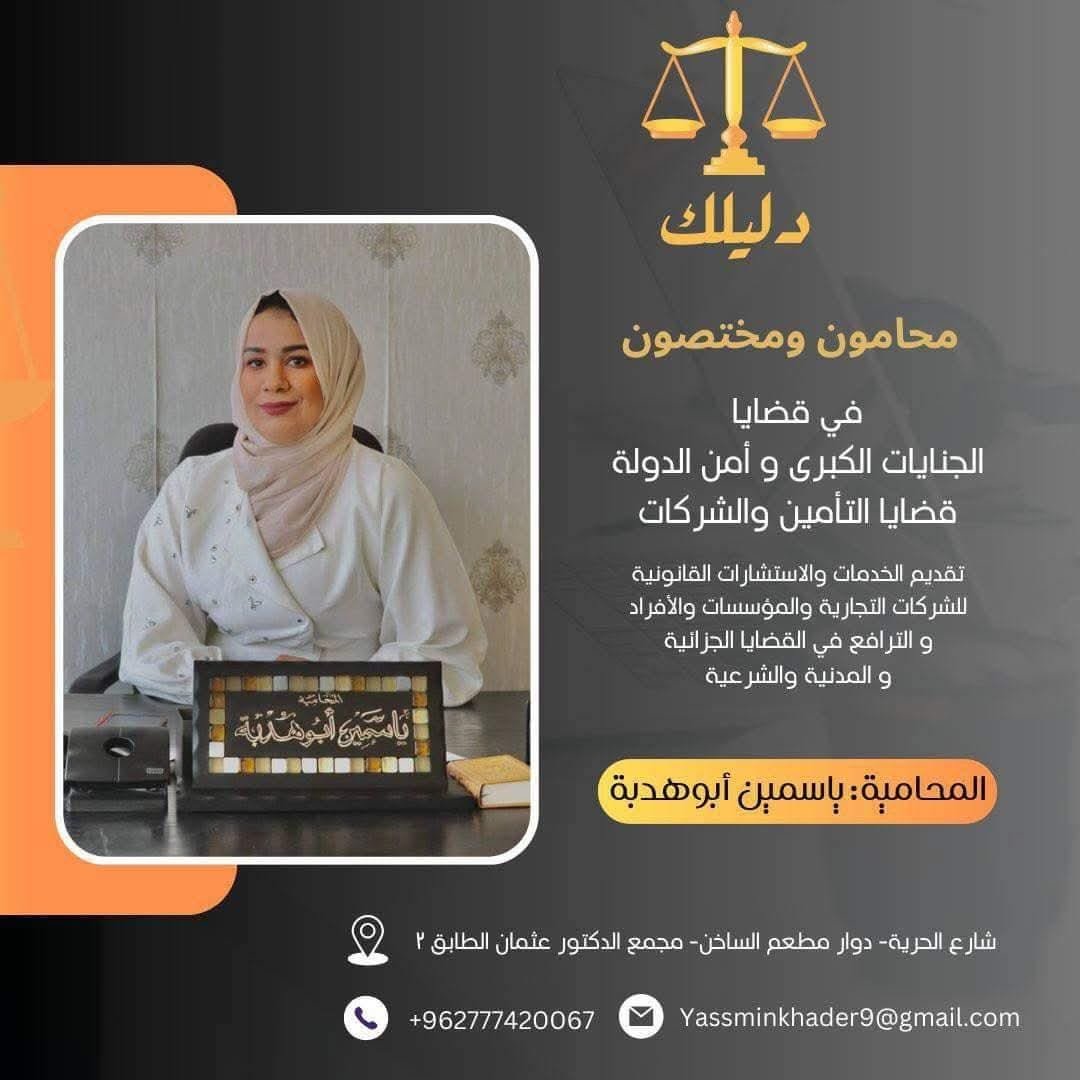
The Sharia courts in Jordan have jurisdiction to hear all sharia cases in Jordan related to the personal status of Muslims, including cases of marriage, divorce, maintenance, custody, inheritance, and wills. Attorney Yasmin Abu Hadba points out that correctly determining the competent court is the first step to ensuring the case proceeds without procedural errors that could delay its resolution.
Jurisdiction is not limited to the type of case alone, but also extends to territorial jurisdiction, which the law usually determines based on the defendant's place of residence or the place where the contract was concluded, in addition to the role of the family reconciliation, mediation, and conciliation offices affiliated with the courts, which have become a mandatory pathway in many cases before reaching the judicial stage, aiming to bring viewpoints closer together and reduce the intensity of the dispute.

Sharia Cases in Jordan
Marriage under the Jordanian Personal Status Law
Jordanian law regulates the marriage contract and determines its essential elements, such as offer and acceptance, the guardian, witnesses, and the dowry, and requires that the marriage contract be officially registered at the Sharia court to ensure legal rights. Attorney Yasmin Abu Hadba confirms that many marital disputes begin because of an unregistered marriage or a deficiency in one of the elements of the contract, which later leads to legal complications.
Jordanian law elaborates on the matter of guardianship in marriage by requiring the consent of the guardian for the marriage of a virgin who has not reached 18 years of age, while granting the judge the authority to override the guardian's objection (i'dal) if it is established that the guardian is preventing the marriage without a legitimate reason. The law also focuses on the concept of marital suitability (kafa'ah), which is considered a right of both the wife and the guardian, and the suitability of the husband is measured by his religious commitment and his financial capacity to pay the dowry and maintenance.
The Dowry and Its Legal Effects
The dowry is an exclusive right of the wife and is established upon the mere conclusion of a valid marriage contract; it may be paid upfront or deferred. Attorney Yasmin Abu Hadba explains that the deferred dowry constitutes a debt owed by the husband, and the wife is entitled to claim it upon divorce or the husband's death, making it one of the most frequently litigated rights in the Sharia courts.
Divorce under Jordanian Law and Its Types
Divorce in Jordan takes several forms, including revocable divorce (talaq raj'i), irrevocable divorce with minor or major separation (talaq ba'in), and in-absentia divorce. Attorney Yasmin Abu Hadba confirms that determining the type of divorce is extremely important, as it entails different legal consequences related to maintenance, the waiting period (iddah), financial rights, and the possibility of reconciliation.
In-Absentia Divorce and Its Procedures
In-absentia divorce occurs when the divorce takes place without the wife being present or without her knowledge. Attorney Yasmin Abu Hadba points out that this type of divorce is subject to special procedures before the Sharia court and entails financial rights for the wife such as maintenance, the dowry, and the deferred portion thereof, and no right is forfeited except by a judicial ruling.
Spousal Maintenance in Jordan
Maintenance is obligatory upon the husband and is one of the sharia cases in Jordan, and the judge determines it based on his income and financial condition. Attorney Yasmin Abu Hadba explains that the husband's refusal to pay maintenance entitles the wife to file a maintenance claim and obtain a binding, enforceable ruling. Maintenance under Jordanian law includes:
Ongoing Maintenance
This includes food, clothing, and housing, in addition to a servant's maintenance if the husband is affluent and the wife is of a social standing that customarily employs domestic help.
Educational Maintenance
Jordanian law obligates the father to cover the children's educational expenses until they complete their first university degree or reach working age.
Medical Maintenance
The costs of medical treatment and medication are considered an integral part of the maintenance owed by the person obligated to provide support.
Child Maintenance and Its Regulation
Child maintenance is an established right that is not forfeited except in specific circumstances, and it includes food, education, medical treatment, and housing. Attorney Yasmin Abu Hadba confirms that the Sharia court places the best interests of the child first when assessing and enforcing maintenance.

Sharia Cases in Jordan
Custody under the Jordanian Personal Status Law
Custody aims to care for the child and provide a safe environment for them. Jordanian law grants the mother the right of custody up to a certain age unless there is a legitimate impediment. Attorney Yasmin Abu Hadba points out that custody cases are always decided according to the best interests of the child in custody, not merely the wish of one of the parents.
Jordanian law sets the age of custody at 15 solar years for both boys and girls, after which the child in custody may choose to live with either the father or the mother. The law also sets strict controls on the travel of the child in custody outside the Kingdom, requiring the consent of the guardian or permission from the Sharia judge to ensure that the right of visitation or the child's stability is not harmed.
Regulating Visitation and Accompaniment
The law regulates the right of visitation for the non-custodial party, and this is considered a right of the child before being a right of the parent. Attorney Yasmin Abu Hadba explains that the court determines the times and places of visitation in a manner that achieves balance between the rights of the parties and preserves the child's psychological wellbeing.
Obedience and Disobedience (Nushuz) Cases
The Jordanian Personal Status Law addresses obedience and disobedience (nushuz) claims within strict legal controls. Attorney Yasmin Abu Hadba confirms that these claims are not accepted unless the conditions of the sharia-compliant marital home and proper cohabitation are met, in order to preserve the dignity of the wife.
Inheritance and the Division of Estates in Jordan
The Sharia courts hear inheritance cases in accordance with the provisions of Islamic Sharia and the sharia cases in Jordan, whereby the heirs are identified and their shares precisely determined. Attorney Yasmin Abu Hadba points out that disputes over estates are among the most complex cases and require precise legal expertise to avoid injustice or exclusion.
One of the important particularities of Jordanian law is the application of the mandatory bequest (al-wasiyyah al-wajibah) system, which guarantees the children of a deceased son or daughter — who died while their grandfather or grandmother was still alive — a share in the estate within the limits of one-third, in order to achieve social solidarity and protect grandchildren from poverty or exclusion from inheritance.
Read also:When Does a Case Become Time-Barred Under Jordanian Law?
Litigation Procedures Before the Sharia Courts
Litigation procedures in sharia cases in Jordan follow a precise legal path that ensures the sequence of the case from registration to the issuance of a final ruling, which is as follows:
- It begins with filing an official statement of claim with the clerk's office of the territorially competent court, paying the prescribed legal fees, and setting a date for the first hearing.
- The other party is notified with a copy of the statement of claim through process servers or approved electronic means, to ensure the defendant is informed and has the right to respond.
- The parties present their evidence — witnesses, documents, expert opinions — during the hearings, with each party given sufficient opportunity to discuss the opposing party's evidence.
- In certain cases, the case is referred to the family reconciliation offices in an attempt to reconcile the parties before the final judicial decision.
- The process concludes with the issuance of the judge's ruling, which is subject to the legal appeal periods, after which it becomes an enforceable judgment through the Sharia Execution Department.
The Role of the Lawyer in Sharia Cases
The lawyer plays a pivotal role in sharia cases in Jordan by providing legal consultation, drafting statements of claim, pleading before the court, and following up on the enforcement of rulings. Attorney Yasmin Abu Hadba confirms that having a specialized lawyer reduces legal errors and increases the chances of obtaining a fair ruling.
The lawyer manages the case file from the reconciliation offices and the documentation of settlements, all the way through to presenting substantive defenses, ensuring that no rights are lost due to a lack of familiarity with deadlines, and overseeing enforcement to ensure that dues are actually collected, sparing clients the burden of direct confrontations.
The Importance of Early Legal Consultation
Early legal consultation in sharia cases in Jordan saves a great deal of time and effort and protects rights from being lost. Attorney Yasmin Abu Hadba emphasizes that delaying consultation may lead to the loss of rights that cannot be recovered later, ensuring the individual acts within the correct framework set out by Jordanian law:
- Consultation helps in learning the specific legal time limits for filing cases, such as appeal periods or dowry claims, thereby preventing the loss of a right due to the passage of time.
- It allows the litigant to understand the strengths and weaknesses of their position before starting proceedings, reducing the likelihood of losing the case due to errors in drafting the statement of claim.
- It contributes to resolving disputes more quickly, often leading to amicable solutions or settlements that spare the parties from paying court fees and additional expenses for years.
- The legal advisor directs the client toward the type of evidence accepted under both sharia and law, such as proof by testimony or written documents, to ensure it is presented at the appropriate legal time.
- Knowing the expected outcomes of the case based on the provisions of the Personal Status Law gives the parties peace of mind and reduces the tension associated with family disputes.
Frequently Asked Questions
Is the wife entitled to claim past-due maintenance?
Yes, she is entitled to claim accumulated maintenance for a prior period not exceeding two years from the date the case is filed.
At what legal age does child maintenance end?
It continues for male children until they reach working age or complete their first university degree, and for females until marriage or employment.
Does the mother lose custody if she marries someone unrelated to the child in custody?
Yes, under Jordanian law, custody is forfeited if the mother marries a man who is not a mahram (prohibited relative) to the child in custody, unless the child's best interests require otherwise.
Can an increase in the maintenance amount be requested after a ruling has been issued?
A maintenance adjustment case may be filed after one year has passed since the ruling, or if new emergency circumstances arise.
What is the penalty for a husband who fails to register a divorce?
Jordanian law penalizes with imprisonment or a fine any husband who pronounces a divorce and fails to register it with the court within 15 days.
Sharia cases in Jordan represent the cornerstone of regulating family life, and the Jordanian Personal Status Law has come to achieve justice and balance between the parties. Legal awareness and seeking the assistance of a specialized lawyer such as Attorney Yasmin Abu Hadba remain the most important factor in protecting rights and ensuring access to fair and stable legal solutions.
Learn more:Everything You Need to Know About In-Absentia Divorce Under Jordanian Law
Rights of Persons Subject to Deportation Orders and Legal Appeal Procedures in Jordan