This research aims to shed light on the legal procedures followed in the Sharia courts, and the way in which the weaker party in the marital relationship is protected, and to ensure that swift justice is achieved, balancing the man's right to divorce with the woman's right to dignity and financial security.
What Is In-Absentia Divorce in Jordanian Law
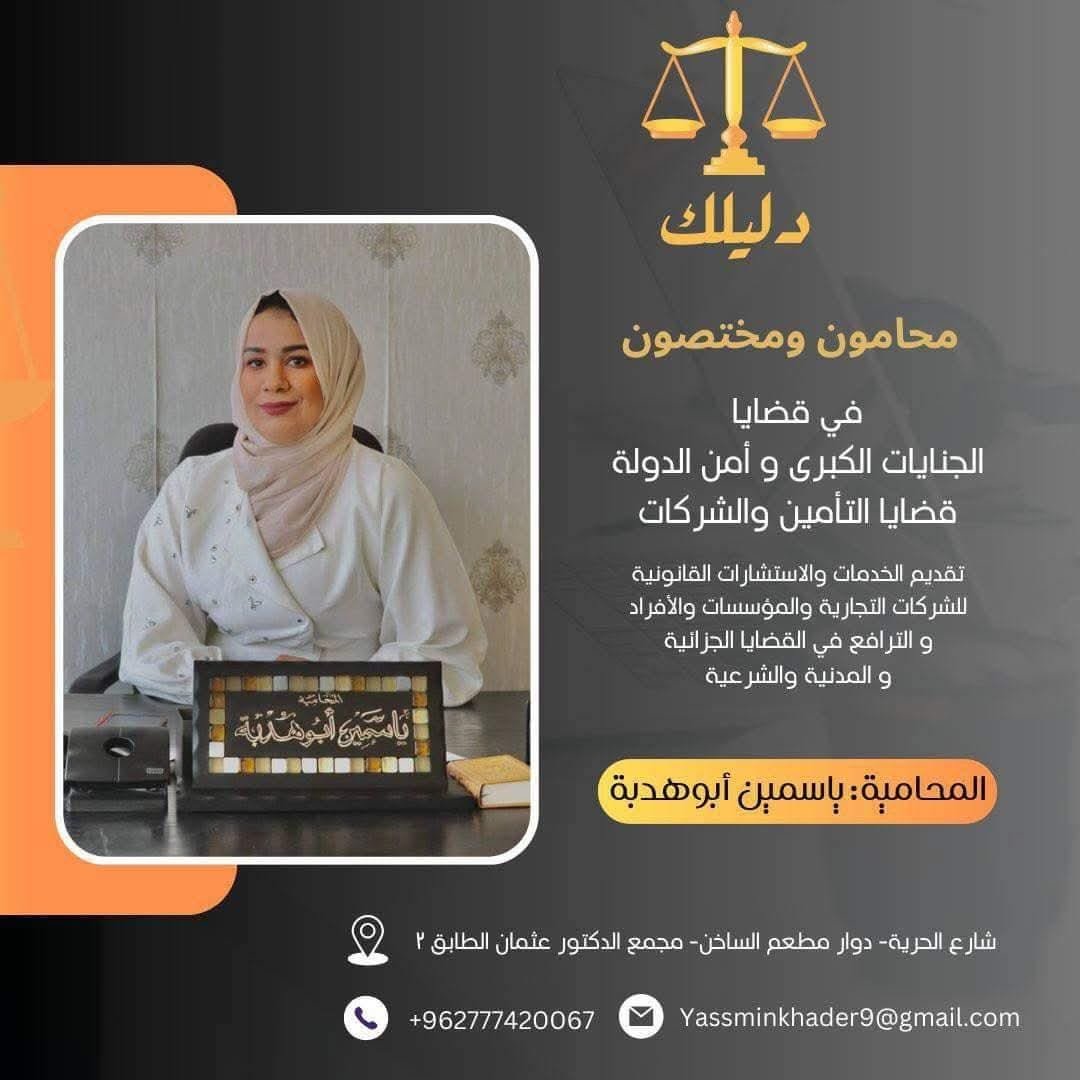
In-absentia divorce under Jordanian law is defined as divorce pronounced by the husband through his unilateral will, without the wife being present before the Sharia judge or having prior knowledge of its occurrence. According to Attorney Yasmin Abu Hadba, this type of divorce is considered legally valid and enforceable once its Sharia elements are satisfied, as the Jordanian legislator has surrounded it with strict controls to protect women's rights.
From a procedural standpoint, the court requires the husband to officially notify the wife of the occurrence of the divorce so that the calculation of her waiting period (iddah) may begin. It also gives rise to important financial effects, most notably the wife's right to claim arbitrary-divorce compensation if it is shown that the divorce occurred without a reasonable legitimate cause, which ensures a balance of rights and prevents one party from dominating the other.

In-Absentia Divorce in Jordanian Law
When Is Divorce Considered In-Absentia in Jordan
The concept of in-absentia divorce under Jordanian law crystallizes when the husband pronounces the divorce formula outside the walls of the court, or in the court session with his presence alone and without the wife being present, so that it may subsequently be documented in the records of the competent Sharia courts.
Attorney Yasmin Abu Hadba also explains that the main criterion for characterizing a divorce as in-absentia is not limited to the physical place where it occurred, but rather rests on the wife's lack of knowledge of the divorce at the moment it was pronounced, which requires subsequent official notification procedures in order to preserve her rights arising from this separation.
What Are the Procedures for Registering an In-Absentia Divorce with the Sharia Court
Jordanian law requires adherence to a specific procedural path to ensure the legality of the in-absentia divorce and to protect the legal standing of the parties. These procedures are as follows:
- The law requires the husband to take the initiative to register the occurrence of the divorce with the competent Sharia court, as the divorce is not legally recognized unless it is officially documented in the state's records.
- The court undertakes to examine the request to register the divorce carefully to ensure that the formula conforms to the Sharia conditions and satisfies all the legal elements required for the validity of the decision.
- The wife is officially notified of the occurrence of the divorce, this being an essential procedure for arranging the effects of the waiting period and subsequent financial claims.
- Attorney Yasmin Abu Hadba points out that delay in registering the divorce opens the door to complex judicial disputes, ranging from difficulty in proving marital status to the loss of the financial and legitimate rights arising from the separation.
Notifying the Wife and Its Effect on In-Absentia Divorce in Jordanian Law
The importance of the procedure for notifying the wife of the in-absentia divorce in Jordanian law centers on the following:
- Attorney Yasmin Abu Hadba confirms that officially notifying the wife is considered the starting point for arranging the legitimate effects, as the calculation of the waiting period and the obligations connected to it does not legally begin except from the date on which it is established that the wife had knowledge of the occurrence of the divorce.
- Notification also fundamentally aims to break the state of being kept uninformed, as it allows the wife to exercise her right to defend her legal entitlements and to submit her financial claims without delay or procrastination.
- The wife cannot proceed with procedures to collect the deferred dower (mu'akhkhar), waiting-period maintenance, or claim arbitrary-divorce compensation except after the notification procedure has been completed officially through the means specified by law.
- Notification prevents the husband from exploiting the element of absence to evade his financial responsibilities or to manipulate the time periods set by Sharia and law to protect the woman's standing after separation.
What Are the Wife's Rights After an In-Absentia Divorce
In-absentia divorce under Jordanian law gives rise to a set of financial and legitimate rights that are not extinguished by lapse of time, represented in the following:
- The deferred dower becomes a preferred debt payable immediately upon the occurrence and documentation of the divorce, and the husband has no right to delay paying it.
- The woman divorced in absentia is also entitled to maintenance covering food, clothing, and housing for the waiting period, the calculation of which begins, both religiously and legally, from the date she is officially notified of the divorce.
- Attorney Yasmin Abu Hadba points out that the Jordanian judiciary grants the wife the right to claim arbitrary-divorce compensation in the event the husband pronounced the divorce without a valid legitimate cause, this being a financial compensation assessed by the judge to redress the harm suffered by the wife.
- The Sharia judiciary examines cases of in-absentia divorce with strict scrutiny, verifying whether there is bad faith on the part of the husband or attempts at deception, so that no financial or moral right of the wife is lost due to her absence from the divorce session.
- The wife's absence from the occurrence of the divorce does not affect her original right to the custody of her children and to securing the maintenance necessary for them in accordance with the standards set by the Personal Status Law.

In-Absentia Divorce in Jordanian Law
Is It Permissible to Object to an In-Absentia Divorce
No, the objection is not directed at the husband's right to pronounce the divorce itself, but rather is legally focused on the procedures and effects. Attorney Yasmin Abu Hadba explains that once its Sharia elements are satisfied, the in-absentia divorce occurs validly, but the wife has the right to object before the Sharia court in the event there is a defect in the notification procedures, or to claim her financial rights arising from this divorce.
The purpose of resorting to the judiciary is not to annul the occurrence of the divorce, but rather to ensure that the wife's legal rights are not usurped, or to prove that an act of arbitrary divorce occurred requiring financial compensation, which makes the objection a tool for protecting entitlements rather than for preventing the divorce itself.
The Role of the Sharia Court in In-Absentia Divorce Cases
The Sharia court undertakes the responsibility of legal and religious oversight over in-absentia divorce under Jordanian law through the following:
- The court acts as the sovereign reference for registering the occurrence of the divorce, as it verifies the husband's legal capacity and the validity of the divorce formula and its conformity with the provisions of Sharia and the Personal Status Law before formally confirming it.
- The court is also obligated to ensure that legal notice reaches the wife through process servers or other approved means, in order to close off any attempt to conceal her rights or hide the occurrence of the divorce from her.
- Attorney Yasmin Abu Hadba points out that the court's intervention aims primarily at protecting the weaker party by adjudicating financial disputes, in addition to fairly assessing the value of the maintenance and compensation due to the wife.
- The court plays a balancing role between the husband's right to end the relationship and the necessity of protecting the wife's dignity, by preventing arbitrary conduct and ensuring that no legitimate or financial right is lost due to the wife's absence from the divorce session.
Read also:The Reasons for Deportation and the Legal and Social Consequences of Deportation in Jordan
What Is the Importance of Legal Consultation in Cases of In-Absentia Divorce Under Jordanian Law?
Engaging a lawyer specialized in personal status cases is considered a pivotal step to ensure justice, its importance being represented in the following:
- Early legal consultation helps in characterizing the divorce case and establishing the wife's rights based on the details contained in the case file, giving her a clear view of her position before the judiciary.
- Attorney Yasmin Abu Hadba also points out that a specialized lawyer works to formulate the financial claims — dower, maintenance, and arbitrary-divorce compensation — in a sound legal manner that prevents the loss of any part of them or delay in obtaining them.
- Legal expertise contributes to monitoring the validity of notification procedures and the legal periods for appeal, which protects the wife from forfeiting her rights due to missed deadlines or unawareness of procedural loopholes.
- The lawyer has the ability to gather evidence and characterize the facts to prove the husband's bad faith or arbitrary conduct, which is a fundamental pillar for maximizing the value of the compensation awarded.
- Specialized consultation ensures speed of judicial action, which shortens the duration of litigation and secures the wife's livelihood and legitimate rights in the shortest possible time.
Frequently Asked Questions
Does an in-absentia divorce occur as soon as the husband pronounces it?
Yes, it occurs both religiously and legally, but its official effects are only calculated from the date the wife is notified or has certain knowledge of it.
Is the wife entitled to compensation for an in-absentia divorce?
Yes, she is entitled to claim arbitrary-divorce compensation if it is established before the judge that the husband pronounced the divorce without a legitimate cause or legal justification.
In-absentia divorce under Jordanian law is a legitimate legal system, but one that carries sensitive legal effects requiring precise legal awareness. Attorney Yasmin Abu Hadba explains that correct knowledge of the procedures and rights, in addition to resorting to specialized legal consultation, is considered the best way to protect rights and ensure that justice is applied in accordance with the provisions of Jordanian law.
Learn more:The Role of a Specialized Lawyer in Drug and State Security Cases in Jordan
How Are Legal Contracts Prepared and Drafted?
Dealing with Seized Narcotic Substances and Their Effect on the Judicial Ruling